Every so often I have an idea to found and edit a museums journal, it would be called: ‘Museums can be better’. All Museums can be better (very general I know) but I am interested in particular in improvements being made with a visitor-focus; this could be in interpretation of artefacts, the use of the museum building, in the focus on visitors use or indeed in encouraging visitors to return to museums. Also, I know that the last point sounds really basic but – if a museum is really a hub for the community – then shouldn’t it be part of the ‘Mission Statement’ to encourage re-visitation?
This was an idea that I had in 2019 and I have not done anything of the sort. I have written 3 articles and I am still waiting for them to be published: academic publishing moves slower than I thought.
So, I will instead every so often I will write a little review of a museum or Art Gallery that takes my fancy. It is more than a coincidence that many of the points that I will raise in these ‘reviews’ will either form part of, or all of an argument written in an article to be published.
A note for later on, if I refer to a museum, I could also be referring to an Art Gallery – I like visiting both.
Review begins here: Southampton City Art Gallery
I like Southampton City Art Gallery. I have visited the Art Gallery many times and I have worked there whilst a student; there is a lot that I like about the gallery and two things that I don’t like about the gallery. I have not visited the Art gallery; I haven’t visited any museum since March 2020, I do hold the Art Gallery in high esteem. I have included three links, 1). Southampton City Art Gallery, 2). Art UK Collection, 3). A ‘thing link’ interactive of the Sir Edward Burn-Jones Perseus Collection, 4). The Art Gallery collection page:
1). Southampton City Art Gallery: https://www.southamptoncityartgallery.com/
2). Art UK: https://artuk.org/visit/venues/southampton-city-art-gallery-4670
3). The Baring Room & Perseus Collection by Sir Edward Burn-Jones: https://www.southamptoncityartgallery.com/whats-on/perseus-series/
(Scroll to the bottom of the page for the interactive)
4). Art Gallery Collection: https://www.southamptoncityartgallery.com/collection/
The Art Gallery is located within Southampton Civic Centre, where it was moved in 1939. Ever since the Art Gallery has been part of the colossal ‘NeoClassic’ building designed by the architect Ernest Berry Webber (1896-1963) it was opened by the Duke of York in 1937, it shared the rest of the building with Southampton Court House – now Sea City Museum (opened 2012)– and there is also a library.
The Art Gallery occupies only 1 floor and consists of a eight smallish galleries that seem to be divided into three distinct areas.
Within one ‘wing’ of the Art Gallery is located the ‘Baring room’ and this room is there specifically for the exhibition of the Perseus Collection. These are a cycle of preliminary cartoon studies made by Sir Edward Burn-Jones who was commissioned in 1875 by Arthur Balfour (Politician and later Conservative PM between 1902-1905) these would be studies for the resulting oil paintings. I am completely biased when I say these are fantastic and deservedly attract people from all over the UK, Europe and the USA (I know this because I have been asked where they are when I am at work).

As nice as pre-Raphaelite art is, in the Art Gallery I feel myself attracted more to the abstract – though not exclusively so. At the moment I must say that I do have favourites and one is ‘Rectangular motif: Red and Mustard’ from 1950 by Victor Pasmore. I have included a photograph and also you can find it on Art UK – but none of these do it justice, the colours are either too vibrant or too muted (My reflection in the frame doesn’t help).
The Art Gallery has in their collection over 5,200 paintings and I am pretty sure that I have only seen a tiny percentage. Indeed, if you can, look at their collection in Art UK. The Gallery seems to rotate their collections, though this can be ever month or few months, and if you return to the Gallery, you should be able to see a new exhibition or a collection of paintings that you previously were unaware that ever existed. Unfortunately, before the pandemic this rotation seemed to have slowed down and what paintings were being re-exhibited tended to be from regular occurrences. Repetition of popular paintings for exhibition, over a period of a year, was I thought disappointing; given the limited space of the Gallery, their collection rotation had in the past brought out interesting and challenging, that may not have been everyone’s cup-of-tea but it made the most of the space and exposed the returning visitor to a vibrant and well-curated Art Gallery.
As I have worked there (on-and-off) since 2012 the Art Gallery have had exhibitions on: London School, Cubism, Leonardo Da Vinci, and most recently on the pre-raphelites. In a nicely curated exhibition, that was divided into schools of thought that was not limited to exhibiting a chronological progression this drew large crowds. Not my favourite, but all were beautiful paintings. Such as this painting by Ford Madox Brown Cordelia’s Portion (1867-73)
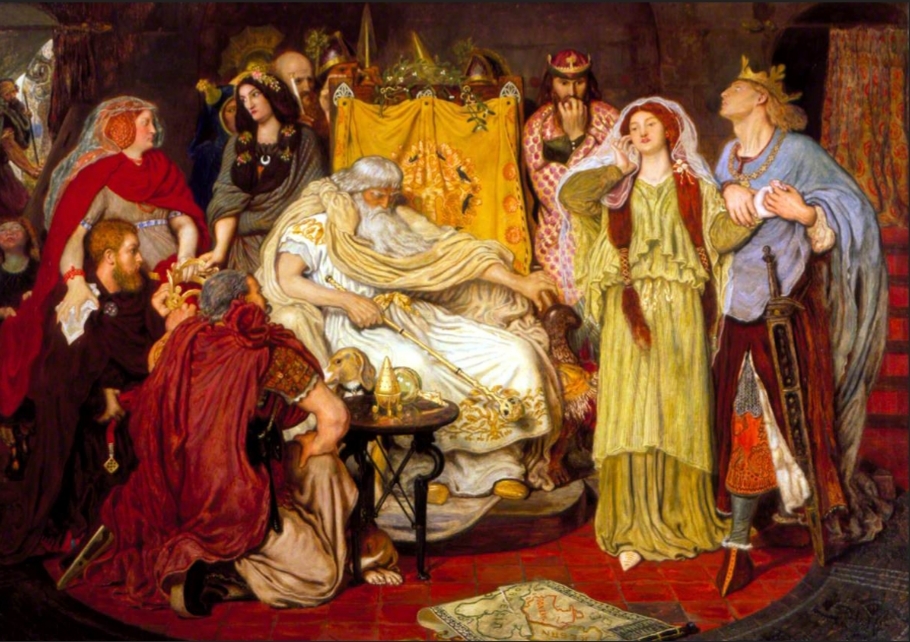
Ford Madox Brown
Southampton City Art Gallery
Or this symbolic retelling: The Pleiades by Bernard Sleigh (1872-1954) in which Orion Hunter is on the hunt with Pleiades accompanied by two Unicorns ‘the Monoceros’ and aided by ‘Canis Major’ and ‘Canis Minor’.
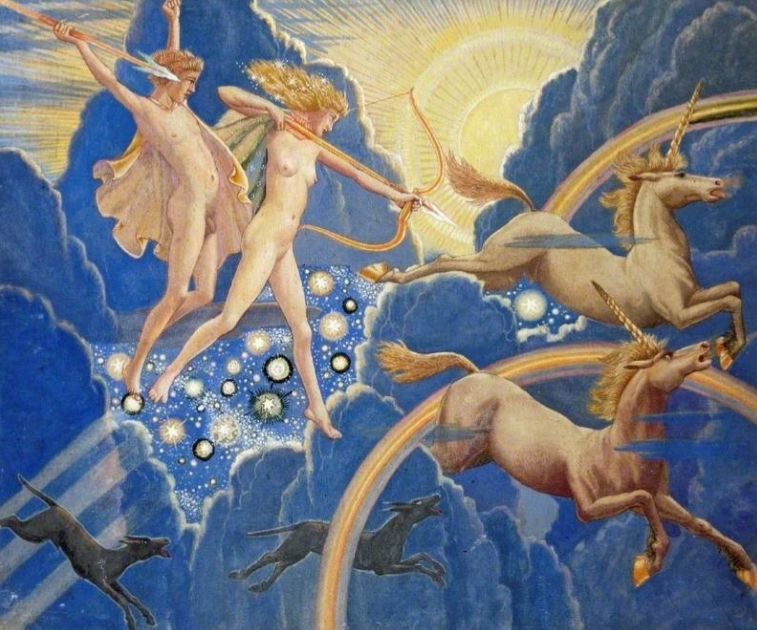
Bernard Sleigh (1872-1954)
Russell-Cotes Art Gallery and Museum
Exhibited as part of the Pre-Raphelite exhibition
However, the Art Gallery does not seem to rest on it’s laurels for too long; this exhibition had been extended due to popularity but this exhibition was eventually changed.
In the next gallery there was indeed a change of tone, an exhibition of the original historic collection. The rather nice thing about this exhibition was that we got to see paintings that at least I had never seen before.

This however, brings me to a two negative points about the Gallery. The first is the upkeep, in central hall there is unfortunately peeling plaster on the ceiling: this is otherwise a lovely main hall but even in this photo, it can be seen.

The second, and I think most important to the enjoyment paintings of the Art Gallery is the size, positioning and the design of the interpretive text displayed by the painting. It does seem that there is as unfortunate reliance on ‘Times New Roman’ size 10-12 and positioned away from the painting. It is a pity, reliance this means walking to find the interpretive text – when you are standing admiring the entirety of a painting you are standing at quite a distance from the painting – what are the chances that you could read a little type-size 10 – why not make this text bigger, focussing on fewer details and position it at a way that is accessible (this is the topic of an article to be published in the latest edition of the book Museum Ideas).

David Inshaw 1980
Victoria Art Gallery
Anyway, I like the Art Gallery and I usually feel better for visiting (also the staff are really nice people).

Malcolm Drummond (1880–1945)
Southampton City Art Gallery
This is a painting that seems to attract me:
Evening by Theodore Rousseau (1812-67)

All of these photos were either taken by me with permission of the Art Gallery or they were taken from the publically accessing Art UK website.
I look forward to the next time I can visit the Art Gallery.
 Curious